

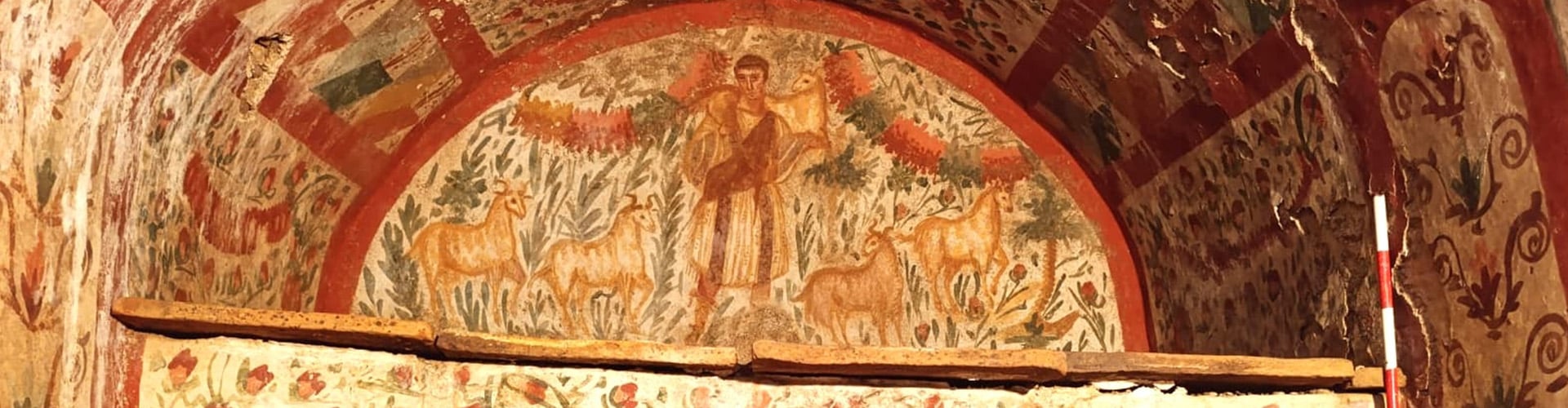
One of the most important recent discoveries from the Early Christian period was unearthed in the district of İznik, Bursa, in the southern Marmara region of Türkiye. A unique tomb chamber with a depiction of 'Good Shepherd Jesus' on its walls was discovered during excavations at the Hisardere Necropolis. The international launch of the tomb chamber was organised during Pope Leo XIV’s visit to Türkiye.
This hypogeum, identified in the 2025 studies, is among the most special finds in the area with its tomb, frescoes, and iconography. The depiction of 'Good Shepherd Jesus' on the walls of the structure is considered one of the best-preserved examples identified in Anatolia to date. The interior arrangement of the tomb chamber, built of brick and rubble stone, draws attention as another element that enhances the structure's significance. Inside the tomb, there is a kline (a rectangular-shaped, four-legged piece of furniture similar to a divan or settee) decorated with vegetal motifs and paired bird figures. On top of the kline, there are three burials: two for adults and one for a baby.
A Special Example of Early Christian Art
In the composition on the kline, a figure of 'Good Shepherd Jesus' is seen, depicted as a young man with a lamb around his neck. The image bears similarities to the sculptural groups exhibited at the Pio Cristiano Museum in the Vatican and to the frescoes found in the underground tombs of Priscilla, Petrus–Marcellinus, and Domitilla in Rome.
The fact that such a solid example of this iconography has not been encountered before in Anatolia elevates the structure to an exceptional position on an international scale. Scenes depicting Jesus as a shepherd hold an important place in early Christian art. The 'Good Shepherd' theme is particularly known as a frequently used iconography in tomb decorations during the early Christian period of the Roman Empire. This depiction creates a visual language that combines symbols from pre-Christian Greco-Roman traditions with religious interpretations.
The frescoes on the long side of the tomb chamber are still under excavation. In the exposed sections, noble portraits of women and men are depicted sitting on a bench, considering portrait art. Immediately beside them, there are two servant (slave) figures, one on the left and one on the right, depicted smaller than the main figures and serving as attendants.
Mehmet Nuri Ersoy, Türkiye’s Minister of Culture and Tourism, accompanied Pope Leo XIV during his visit to Türkiye. The President of the Republic of Türkiye, Recep Tayyip Erdoğan, presented a tile painting of the discovery to Pope Leo XIV during his visit to Türkiye.
Türkiye, with its impressive Christian routes, adds a new destination to its offerings with this new finding
Although there is no directly datable find in the tomb chamber, the architectural order, fresco technique, and stylistic analyses indicate that the structure dates back to the 3rd century AD. And this site is one of Türkiye’s many Christian faith routes.
Türkiye hosts rich cultural routes for those wishing to explore the early heritage of Christianity. One of the most significant of these is the St. Paul Trail, which traces the regions of Anatolia where St. Paul, born in Tarsus between 5 and 10 CE, spread his teachings. Stretching approximately 500 km from Perge to Psidia Antioch (Yalvaç), this route passes through ancient Roman roads, mountain villages, and forest trails, offering both a historical and cultural experience. Today, the St. Paul Trail is more than just a walking path; it is an unforgettable historical journey that offers visitors a glimpse into Anatolia's layered religious and cultural heritage.
Another important trail is the Seven Churches of Revelation. As mentioned in the New Testament, the remains of the “Seven Churches of the Apocalypse” or the “Seven Churches of Asia” are located in the Aegean region of Türkiye. These structures are significant in the history of Christianity, both as the primary focus of the first three chapters of the Book of Revelation and as actual places that played critical roles in the spread of Christianity. St John (John the Baptist) also lived in Ephesus, the location of one of the churches. In addition, it is believed that the Shrine of the Virgin Mary is also located in the region.
Cappadocia, the rocky wonderland in the centre of Türkiye, is also a very important area for early Christianity. The region became a refuge for early Christians fleeing Roman persecution, who created a network of underground settlements carved by hand. Monks excavated extensive dwellings and monasteries, then adorned them with beautiful frescoes.
On the Mediterranean coast, the heritage of St. Nicholas (Santa Claus) in Demre (Myra) highlights another cornerstone of early Christian tradition, drawing visitors to the ancient basilica and the landscapes where this influential figure lived and served.